Exclusive
Three Friends in Torture Chambers
Friends from a biker club in the North Caucasus were caught up in Russia’s crackdown on anti-war dissent. After brutal torture, one of them died.
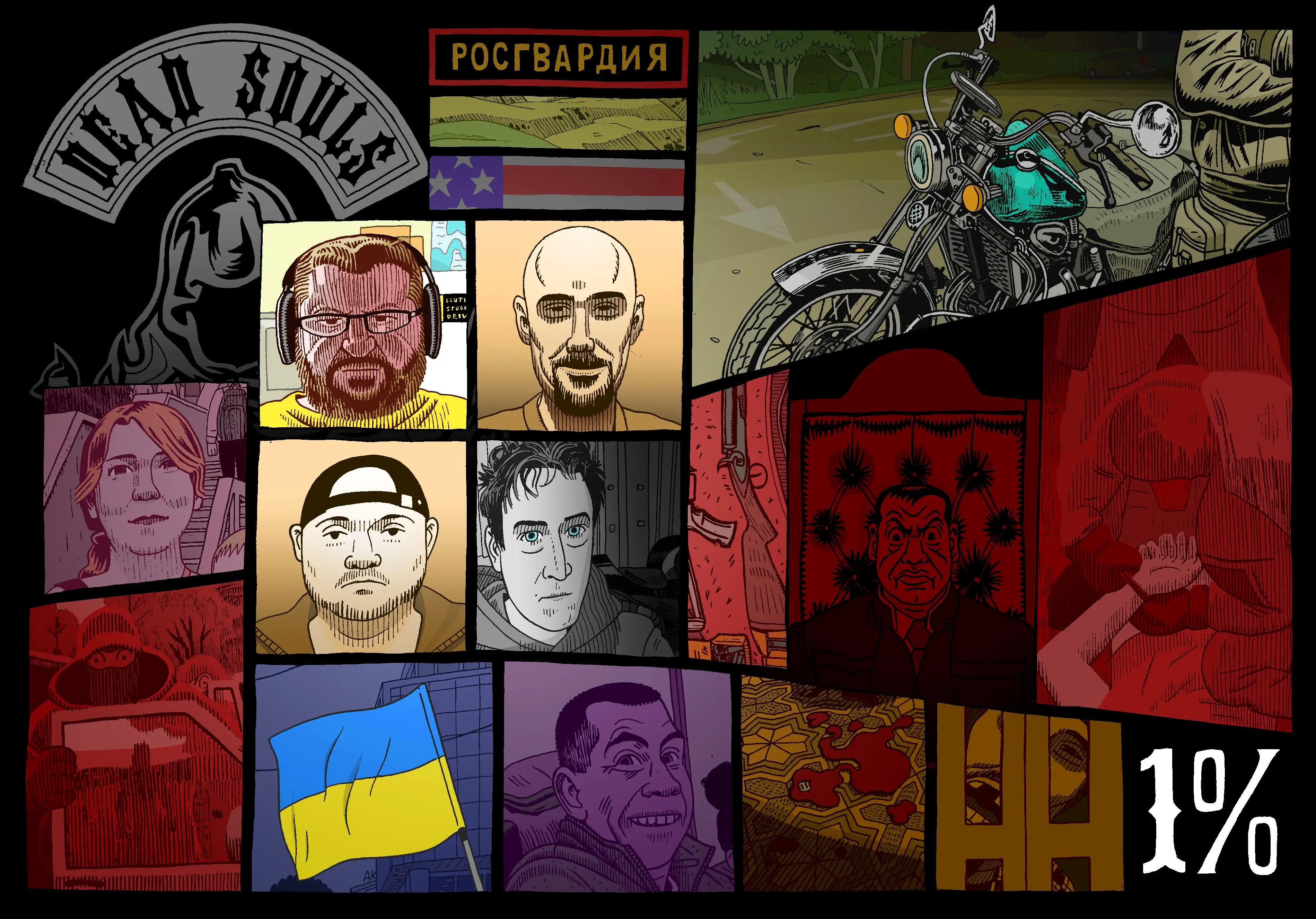
Illustration by Gleb Pushev

Friends from a biker club in the North Caucasus were caught up in Russia’s crackdown on anti-war dissent. After brutal torture, one of them died.
Illustration by Gleb Pushev
The trial that has come to be known as the “Stavropol Bikers Case” has received almost no coverage, either in Russia or abroad. Former clubmates turned their backs on them as traitors, while Russians who left the country over their anti-war views have largely ignored the story too. Journalist Lera Chegge was the only reporter to attend the hearings in Rostov. She spoke with relatives and with the surviving member of the alleged “criminal group” to piece together, in this courtroom report, why such a shockingly inhumane prosecution has remained almost invisible.
Former police officer and National Guard officer Vladimir Burmay left Russia a day before his arrest, shortly after a search of his home. According to him, former colleagues warned him. Burmay is one of the bikers from a club called “Dead Souls” — a reference to Gogol’s novel. He has been convicted in absentia and placed on a wanted list. Two other club members, his friends Sergey Dudchenko and Nikolai Murnev, are defendants in what became known as the “Stavropol Bikers Case.” Two other men were also charged. Kirill Buzmakov died in 2024 from injuries caused by torture, while Rasim Bulgakov testified against his friends and received a suspended sentence.
“I no longer have a purpose in life. I have nothing left. Only revenge — and helping the guys. They’ll get 15 or 20 years. They’ll be sent to such remote places that even their families won’t know where they are,” Burmay says.
Exile has been difficult for him. He lost everything that mattered to him — expeditions to the mountains of the Caucasus, his home, and his friends. He has grown fond of Oregon’s lakes and protected forests, but even after three years he still cannot fill the emptiness.
“I’m a former police officer and a member of the National Guard. It’s like a stigma. No one wanted to look into my background. If you’re a former cop, that’s it — you’re seen as part of the System. No one really trusts you or wants to work with you.”
The FSB has been urging Burmay to return to Russia and testify against his friends. They promise that in that case he would face a less serious charge and get off lightly. But he says he cannot betray them — unlike some other members of the club.
“We always thought we were among good friends, people with moral values who tried to remain human. But we were wrong. In the very first days people we had lived alongside for decades turned their backs on us. Murnev’s own brother renounced him after his mother-in-law — a federal judge — talked to him. He believed his mother-in-law, not his brother. That’s terrifying.”
In the fall of 2024, I decided to write my first letter to a political prisoner. On the Vestochka website, a randomizer gave me Murnev. I read his story and sent a letter. I also joined the support group for the bikers’ case, which was run by his wife. Murnev replied, and we began exchanging letters. In December 2024, I saw a post in the group: a court hearing would take place the next day in Rostov-on-Don, and anyone could attend. Murnev’s wife Anna was living in Georgia at the time. I wrote to tell her that I worked with media outlets, lived in Rostov, and could attend. That is how I ended up at the hearing — the only person in the audience. By the spring of 2025 there were three of us attending: me, Anna, and Dudchenko’s sister.
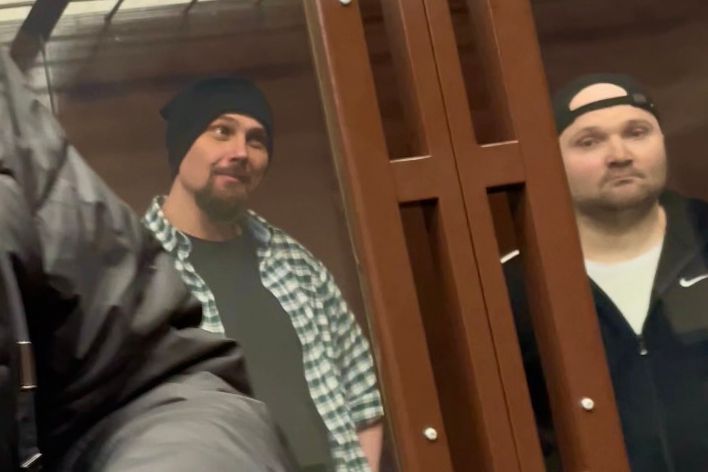
Sergey Dudchenko and Nikolay Murnev in the courtroom.
My article about the trial was not published then. Too much remained unclear, and unlike in cases that receive broad coverage, the editors decided not to rush publication. That was the beginning of months of work on this courtroom report: conversations with the bikers through the glass of the courtroom “aquarium” and in letters, conversations with their families and lawyers, and long hours spent studying the available case materials and human rights reports.
In May 2025, I got in touch with Burmay. We began speaking regularly.He told me about his friends’ lives and how the trial was unfolding, and sent me documents and photographs. He also said he had failed to secure help for them from human rights organizations, and that his own position abroad was precarious because he had served in the National Guard.
Independent Russian media covered them only twice: when they were recognized as political prisoners and after the death of Kirill Buzmakov. Those publications appeared in 2024, and coverage stopped there.
In September 2022, during the mobilization, Murnev received a draft notice. The military enlistment office did not yet know that he and his wife had just had their fourth child, which meant he was exempt from conscription. He brought the child’s birth certificate to the office.
The prosecution now insists he went there for a different reason — not to confirm his exemption, but to conduct “reconnaissance.” According to investigators, his friends had sent him to gather information about the enlistment office in preparation for a terrorist attack. As evidence, the case file cites criticism of Russia’s invasion of Ukraine posted in a private Telegram group chat among friends, as well as weapons and ammunition that the defense says were planted.
The prosecution claims that Dudchenko had been recruited by the Ukrainian armed forces and in May 2022 suggested to his friends that they set fire to the enlistment office. Murnev, Buzmakov, and Burmay allegedly agreed. Investigators say Murnev “conducted reconnaissance of the military enlistment office,” after which the defendants prepared an incendiary mixture in his garage. They were unable to carry out the plan, the prosecution says, because Interior Ministry officers thwarted their “criminal activity.”
Yet the alleged plan was discussed at a house party in early May, while the supposed “criminal activity” was only stopped on October 12 — after Murnev’s visit to the enlistment office.The investigation never explains why the alleged plotters would have needed a four-month pause.
May 2022. A pro-war motorcade marked with the letter Z moves through the streets of Yessentuki, carrying flags in support of the Russian army. Seeing the convoy, Dudchenko mounted a Ukrainian flag on his motorcycle and started the engine. Steering out directly in front of the column, he rode past the tricolors and St. George ribbons and continued through the streets of his hometown. Insults were shouted after him, and someone even threw a plastic bottle of water.
When I asked where he had gotten the Ukrainian flag, Dudchenko sent a message: “In 2011 I traveled through Ukraine and ended up in the town of Sarny in the Rivne region. It was Independence Day. I approached a group of guys who had a lot of flags and asked them to give me one. I said I was from Russia. I added it to my collection, which includes flags of Eastern European countries.”
He later posted photos of the motorcycle with the flag to his Instagram stories, along with a caption supporting Ukraine. He attached a fragment of the song “Обійми” by the band Океан Ельзи with the line “When the day comes, the war will end.”
Burmay sent me a video recording from the temporary detention facility in which Dudchenko tells this story and repeats his message.
“I wanted to show that in our country there are still kind-hearted people who love their Ukrainian brothers, who stand only for peace, who want no war and no bloodshed. Not only to the residents of my town, but to all of Russia through social media. I dedicate my solo motorcycle ride to the endless power of reason, to all people of sound mind, and to the highest justice. I believe that a small grain of wheat can split a mountain in two if truth is on its side, together with a true faith in good and an iron will.”
Nearly half a year had passed. During that time the friends discussed the war and politics in a Telegram chat called “1%.” The name is a reference to a biker identity that emerged after the American Motorcyclist Association declared in the mid-20th century that 99% of motorcyclists were law-abiding citizens. The remaining one percent were those who saw themselves as rebels and sometimes lived outside the law. From the very beginning of the invasion, Dudchenko spoke out against the war and blamed the Putin regime for what he called a criminal attack on a neighboring country.
After fifteen years in law enforcement, Burmay retained not only experience but also contacts, and those contacts suggested that his friends were under operational surveillance. He urged them to be more careful, but it was already too late.
During questioning at the Southern District Military Court in May 2025, Dudchenko described his arrest. On October 8, 2022, he was returning home from his garage when an SUV and several other cars rushed toward him at high speed. Men in masks jumped out and slammed him face down onto the ground. His hands were cuffed behind his back, and for some time they simply beat him. Then they checked whether they had the right person and pushed him into the SUV. Every question he asked was answered with more blows.
Footage of the attack was later shown by the FSB in its report on the operation. But according to the investigation, Dudchenko had been detained by police for swearing in public, and the court rejected a motion to include the FSB video in the case file.
Officers from the Center “E” unit and the FSB also came for Burmay on October 8. Wearing tactical gear and carrying shields, they broke down the gate, seized his phone, and did not allow him to call a lawyer. “You’re done,” they told the bewildered Burmay. They had no warrant for a search. The officers turned the house upside down but found nothing to hold against him. Apparently they were reluctant to plant evidence on a former colleague, and they left empty-handed. Burmay remained at home, but his arrest was only a matter of time.
Within a few days, Burmay says, they came for everyone and “found” drugs, weapons, ammunition and Molotov cocktails. The latter were allegedly discovered in the garage of Murnev, a father of four who already knew Dudchenko had been arrested. A gun was supposedly found lying right on Dudchenko’s porch, in fact at his sister’s house, where no one was living because of renovations.
Each time, officers cited public swearing as the reason for the detention, then later brought drug possession charges, producing substances they claimed to have found in the defendants’ pockets. Only at the end of December were the men formally accused of preparing a terrorist attack.
The bikers are accused of plotting to set fire to a military enlistment office in the Stavropol region “with the aim of destabilizing state authorities and discouraging residents of the Caucasian Mineral Waters region from participating in the military campaign in Ukraine.” The indictment devotes two full paragraphs to the so-called “special military operation.”
Dudchenko and Murnev, along with the deceased Buzmakov and the absent defendant Burmay, are charged with preparing to commit a terrorist act by a group acting in prior conspiracy. The charge carries a possible sentence of up to ten years in prison. Investigators say the motive was that the men were “opponents of the special military operation” and allegedly sought to “destabilize the work of state authorities” and create “an atmosphere of public anxiety and distrust toward the authorities among an undefined circle of persons,” in violation of Russia’s national security strategy approved by presidential decree.
As physical evidence, the prosecution presents two bottles said to contain an incendiary mixture.
The only statements supporting the prosecution’s version are interrogation records attributed to Dudchenko, Murnev, and Buzmakov. The defendants and their lawyers say these documents were written by law enforcement officers themselves and signed under torture.
The records are written in dense bureaucratic language, passages repeat themselves, and even the names of the accused are confused. Other participants in the chat and the gatherings of friends do not mention any criminal conspiracy in their testimony. The Telegram chat “1%” contains no messages that support the prosecution’s claims or even appear relevant to the investigation, but investigators argue that the participants deleted them.
According to Burmay, the chat correspondence was shown to FSB officers by another arrested member of the club, Viktor Shaulov, in exchange for his freedom. Burmay believes Shaulov had attracted the attention of the Center “E” unit earlier by posting Instagram videos accusing the Russian president of war crimes and calling for criminal prosecution. Yet he was the one who got off most lightly: he was released after two days in detention and agreed to cooperate with the investigation.
Kirill Buzmakov was already severely injured on the day of his arrest. Officers beat him so badly that his jaw and a facial bone were broken and several teeth were knocked out. An infection set in soon afterward. Buzmakov spent a year and a half in a pre-trial detention center without medical care. He was not taken to a hospital, apparently to prevent information about the torture from becoming public.
In May 2024, Buzmakov was released under house arrest in critical condition and finally underwent surgery. His jaw and tongue were removed completely. He breathed through a tracheostomy and was fed through a tube. He described this, as well as the torture itself, in private messages to Burmay. Buzmakov believed the worst was behind him and that he would survive.
On July 20, Kirill Buzmakov died at home, apparently from the effects of torture, compounded by Stage IV cancer. The death certificate published by OVD-Info notes that Buzmakov was born in Ukraine. Statements he had signed under torture were read out by the prosecutor at a court hearing in the bikers’ case on October 30, 2025, as evidence for the prosecution. His current lawyers are now trying to determine whether he later retracted those statements.
For six months, through June 2025, I attended every hearing in the bikers’ case, including the repeated questioning of Dudchenko, Murnev, and several witnesses requested by the defense at the Southern District Military Court.
Dudchenko’s testimony is full of sarcasm, but it also contains detailed descriptions of the abuse he says he endured. With each sentence, Judge Dovlatbekyan’s eyes widened. He repeatedly asks Dudchenko to “stick to the point” and to keep his answers shorter. Dudchenko continues his account.
He says that on November 25, 2022, a bag was placed over his head and he was taken to an unknown location. Later, when his lawyer sent inquiries, Pre-Trial Detention Center No. 2 replied that Dudchenko was being held in a temporary holding facility, while the holding facility responded that he was in the detention center. Dudchenko recalls being forced to drink water mixed with Corvalol, being shocked with electricity, and beaten. He says the officers told him that if he “confessed to everything and signed,” the torture would stop.
Among other things, he was told to confess that he was a secret agent of the Ukrainian security service. By the time he was finally delivered to the holding facility, he could barely stand. During these interrogations, seven of his teeth were knocked out.
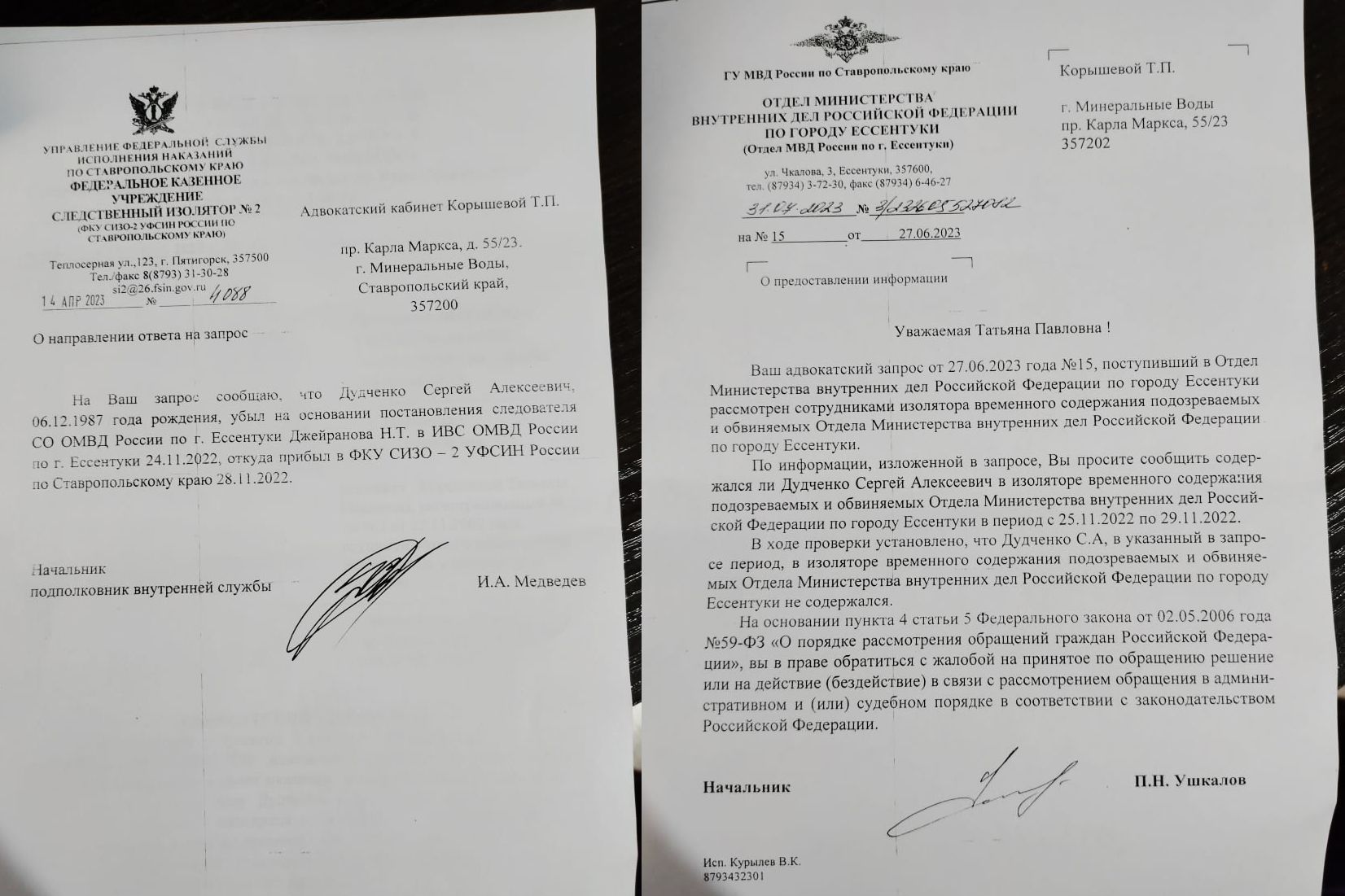
The case file includes contradictory replies from the detention center and the holding facility to his lawyer’s inquiries.
After that, throughout 2023, senior FSB operative Aleksandr Osenny and a Center “E” officer, Yury Gamov, regularly reminded Dudchenko that if he wanted to see his relatives, he should nod along in court and agree with everything.
“I asked everyone the same question: why were we treated with such cruelty and why are they trying to pin crimes on us that we didn’t commit? The answer was always the same. I shouldn’t have ridden with a Ukrainian flag, and Shaulov shouldn’t have posted anti-war messages.”
By the end of the hearing, Dudchenko sounds less like a witness than a man delivering his final statement.
“I fully withdraw the confessions I gave earlier. They were obtained in violation of Russian law and of human rights.”
In a letter to me, Dudchenko wrote that he had dreamed of the sea, and that the song “Knockin’ on Heaven’s Door” from the film of the same name about two terminally ill men traveling to see the sea for the first time had been playing in his head all day. When I asked whether he had reconsidered speaking about what happened, Dudchenko replied: “I am convinced of my innocence and my non-involvement in the alleged crime. I intend to defend this position to the end.”
The prosecution questioned operative Osenny and FSB investigator Ilya Beloglazov in September. Both said no one had been tortured, no pressure had been applied, and the defendants had given statements against themselves and their friends voluntarily and in the presence of lawyers.
The court-appointed lawyer assigned to Dudchenko at the time, Vadim Avdeev, also told the court that the confession had been sincere and voluntary. According to Burmay, Dudchenko had never even seen that lawyer.
“After they kept him in a basement for three days and tortured him, instead of calling the lawyer who was representing him in the drug and ammunition case, they brought a new charge about terrorism that wasn’t covered by that agreement. Under that pretext they assigned him another lawyer — a ‘pocket’ lawyer. Of course, his own lawyer would never have allowed him to sign those confessions.”
Dudchenko first reported torture and withdrew his confession in December 2023 during hearings in a separate case accusing him of possessing weapons and drugs. Murnev and his lawyer spoke about torture at the very first hearing in the Southern District Military Court in the terrorism case. In 2024, the defendants’ wives also filed complaints with prosecutors about violence by FSB officers. Burmay’s wife, Maria, wrote that operative Osenny had threatened her as well — warning that she could be turned from a witness into a suspect and sent to pre-trial detention. According to her statement, he demanded that she slander her husband and his friends.
Anna Murneva described in court what happened when she was first allowed to see her husband. At first he could barely speak and was shaking. She noticed bruises on his neck and face. His eyes were red, and he told her he had not slept for five days. Murnev apologized to her through tears. As she later learned, FSB officers had told him that they had raped her and would do so again if he refused to cooperate. They also said she would be imprisoned and their children sent to an orphanage.
During her own interrogation in January 2023, Murneva says investigators threatened her with criminal charges for refusing to testify, and an investigator handed her a prepared protocol to sign. The document lists two rifles instead of the single rifle actually found during the search. The text itself is filled with bureaucratic phrases such as “the measures were carried out on the basis of judicial authorization.”
Later that year, Anna left Russia with the children and moved to Georgia. Soon afterward she filed a complaint with prosecutors about the beatings. The prosecutor’s office replied that a review had been conducted and no violations had been found, although in reality no such review appears to have taken place.
In March 2025 I met Murneva outside the courtroom. She had returned to Russia to testify in defense of her husband and his friend. When she spoke about threats and torture, the judge expressed doubt about her account, noting that she had only heard about the threats, including those directed at her, from her husband himself. Even after testifying for the defense, she was still formally listed as a prosecution witness.
At the same hearing, the court also re-questioned Murnev at the request of the defense. He said he agreed to sign a confession after being beaten, shocked with electricity, and threatened with the rape of his wife. Investigators gave him a prepared statement to sign, and in several places it even contained the name and surname of Bulgakov, who had already given a confession earlier. His lawyer was not present during the interrogation, and the protocol does not contain her signature. According to relatives of the bikers, lawyers working on the case were threatened with the loss of their licenses.
In August 2025 the defense reported that the prosecutor had summoned investigator Roman Chaplygin to testify in the Rostov court, even though, according to the lawyers, he had not worked on the bikers’ case at all. Murnev told the court that he did not remember such an investigator. Chaplygin, however, insisted that he had seen the defendant. According to him, Murnev came to the interrogation in a good mood, calm, clean and “well dressed,” and made no complaints about torture.
Dudchenko and Murnev saw each other for the first time in the glass “aquarium” at the Southern District Military Court on December 11, 2024, two years after their arrests. The hearings are formally open, although information about the case disappeared from the court’s website in the spring of 2025. Local outlets and independent media have not covered the proceedings, and no reporters attend the hearings.
One witness, Danila Pluzhnikov, an acquaintance of the late Buzmakov, testifies by video link. During an earlier interrogation in 2023 he claimed that at a house party Buzmakov criticized Russia’s invasion of Ukraine and allegedly invited him to join some kind of armed group.
“Are you really sure about what you remember from a drunken party?” Dudchenko shouts from the glass cage, leaning toward the narrow gap between the panels. He tries to reach the microphone lying on the lawyer’s table. Dark circles hung under his eyes, but his voice was sharp with sarcasm.
The second witness appears online as well: Tamazi Edisherashvili, a security guard at the Pyatigorsk military enlistment office. According to the interrogation record, Murnev behaved suspiciously during his visit to the office, looking around nervously and attracting the guard’s attention. Edisherashvili’s statement is one of the prosecution’s key pieces of evidence.
A heavyset older man, he mumbles and struggles to get the words out. When the defense lawyer asks how he recognized Murnev, it becomes clear that he never actually knew what Murnev looked like. Visitors present their passports not to the guard but to an assistant.
“How did the surname Murnev appear in your interrogation record? Did you give that name to the investigator yourself?” the lawyer asks.
“No, I didn’t give that surname.”
“Who did you first hear the name Murnev from?”
“The investigator.”
“Did you read the interrogation protocol before signing it?”
“No, I didn’t read it. I just signed it,” Edisherashvili admits.
“Do you confirm the testimony you gave to the investigator?”
“Well, it turns out I don’t. It turns out I was mistaken. I confirm that I let him onto the territory of the enlistment office, and that I was indeed on duty at that time.”
At later hearings, it emerged that the witness had not formally withdrawn his earlier testimony after all. He was reminded that giving false testimony is a criminal offense.
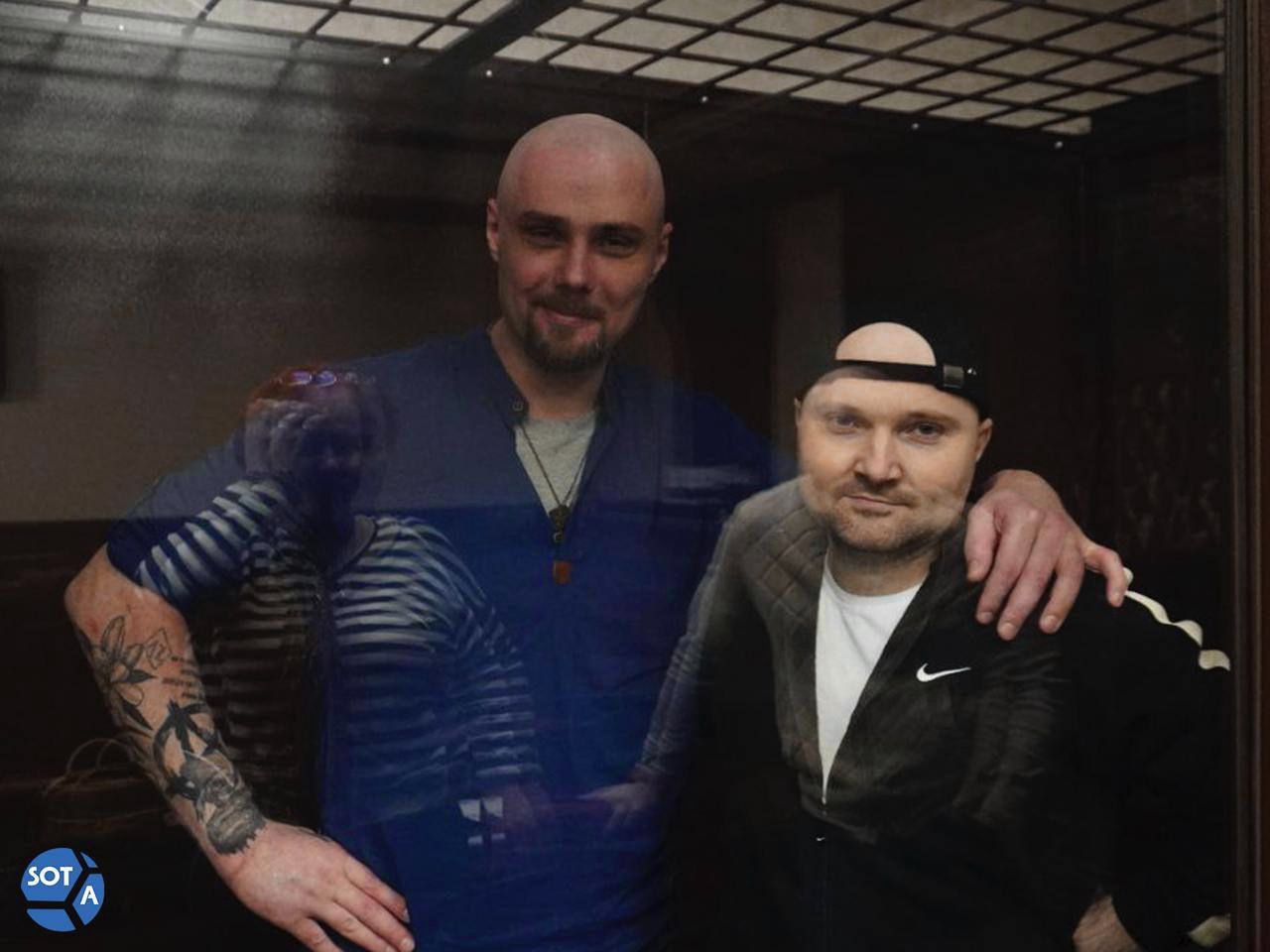
Sergey Dudchenko and Nikolay Murnev in the courtroom. Mikhail Lebedev.
SOTAvision
The prosecutor changed several times over the course of the hearings, but their strategy remained the same: to argue that the confessions obtained under torture are genuine and should be treated as evidence of the bikers’ guilt. A lawyer familiar with the case explained why prosecutors keep summoning law enforcement officers and lawyers to testify despite the near certainty of a guilty verdict.
“Most likely this is driven by the court itself. Allegations of torture were raised, and information favorable to the defense began appearing in the case: a witness withdrawing his testimony, the absence of a defense lawyer during interrogations, reports of torture. So they are trying to counter all of that.”
In October 2024, the human rights project Support for Political Prisoners, Memorial recognized Dudchenko and Murnev as political prisoners, while Burmay and Bulgakov were classified as people persecuted for political reasons. The project’s experts reviewed the case materials and concluded that the defendants were being prosecuted because of their political views, with the aim of silencing criticism of the regime, intimidating society, and maintaining power. The experts also pointed to signs that evidence in the case had been fabricated and that the defendants’ right to a fair trial had been violated. The Anti-War Committee of Russia, together with Avtozak LIVE, included Dudchenko and Murnev in the political prisoners list known as “1000 Names.”
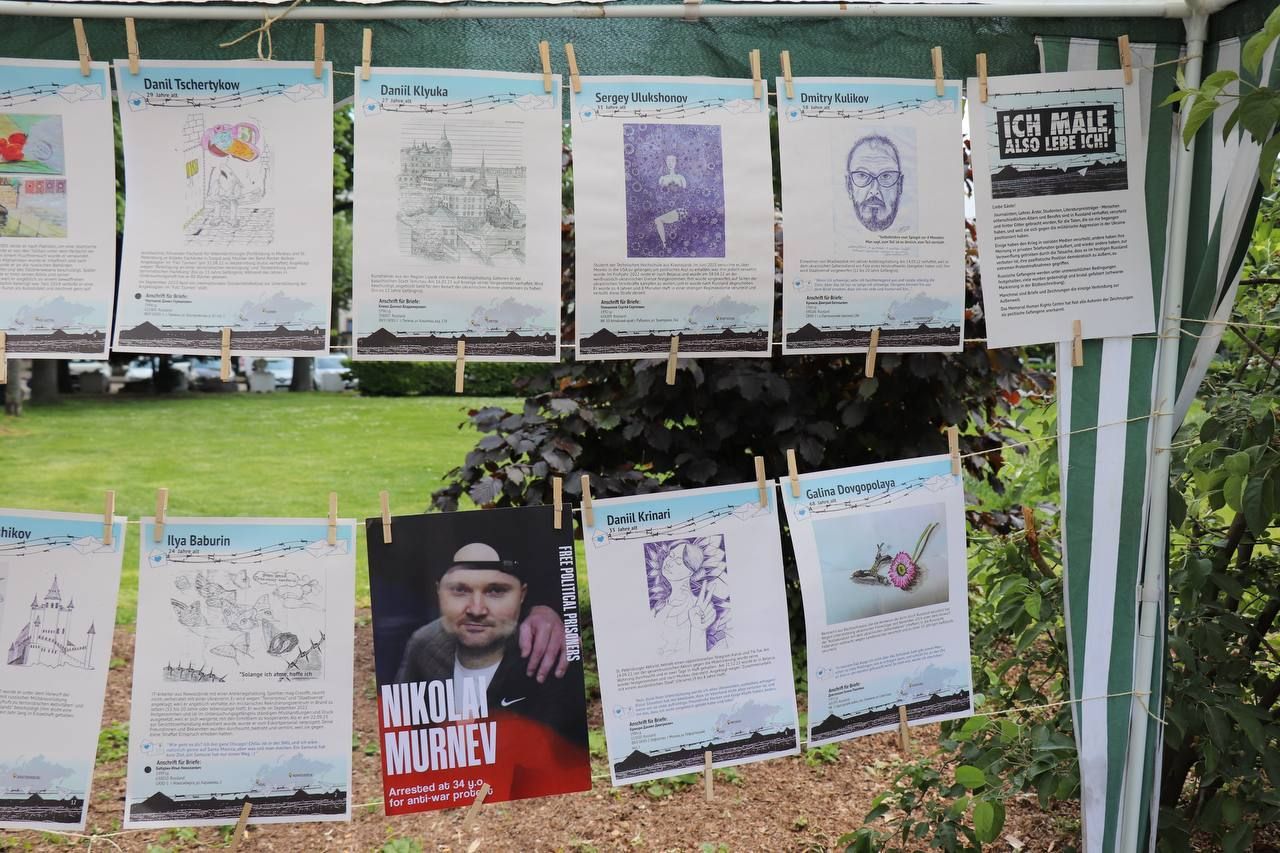
Exhibition in Colmar, France.
Photo from Memorial Center’s social media.
But their own comrades did not stand by them. Burmay was still in the chat groups of biker clubs in the North Caucasus when the case was being discussed there. He says no one even questioned the bikers’ guilt. Friends turned away from what they called a “group of extremists.”
“There are a lot of law enforcement officers in those clubs, even FSB people. Not a single person expressed support. Everyone swallowed the FSB’s version. They display the Z proudly and aggressively. Even those who used to be apolitical suddenly turned into Putin supporters once the war began, and Ukrainians became the enemy. In essence it’s a marginal crowd that now thinks it stands above everyone else.”
The biker communities in the region that Burmay refers to include clubs such as Blacksmiths, whose members include wealthy locals and law enforcement officers, as well as the Night Wolves, known for supporting the invasion of Ukraine and delivering what they call “humanitarian aid” to the Russian army. These clubs have shown unwavering loyalty to the authorities since the start of the war.
According to Burmay, however, the persecuted bikers also failed to find support among Russians who left the country because of their anti-war views.
“When I left Russia, literally in the first days I contacted the only organization I knew — the Committee Against Torture,” he says, describing his attempts to help his friends. “They agreed to help us. They questioned me, and their lawyer Savin went to see the guys. But at first they refused to cooperate with them. They weren’t prepared for the fact that they would be almost killed there. They didn’t know such things could even happen. They were also cut off from outside information and didn’t know I had managed to escape. They were told that I had been arrested too. And before the meeting with the Committee Against Torture they were ‘worked on’ in the cell — told that those people were provocateurs and that they must not cooperate with them under any circumstances.”
“We later met with representatives of the Committee Against Torture in Georgia,” Burmay continues. “They interviewed me, the information was confirmed. But then they closed the case because everyone had refused help. My only complaint about the Committee is that for a whole year they promised to reopen the investigation. Sergey was waiting for them and preparing for it. They kept saying they would come, and then said they had a moratorium and stopped responding. Another staff member in St. Petersburg first said there must have been some mistake and that we would get help, and then she also stopped answering.”
Roman Veretennikov, a lawyer with the project, commented on the situation: “We did not work on this case. We never published any updates about it on our Telegram channel or website. The only thing we did was conduct an initial interview with the applicants together with a lawyer — this is the standard first step in such cases. After that they refused to work with us, and when they later wanted to return we did not take the case on. I don’t remember the reason.”
Burmay also spoke about working with the Memorial Human Rights Center.
“The team did an enormous amount of work. Through their own channels they gathered a lot of information. I am endlessly grateful to them. If we met in person, I would hug and kiss Tatiana Ivanova, the expert who handled the case.”
Ivanova told me that the situation for the bikers somewhat improved after the case reached court and after the public campaign around it.
“Perhaps not to the extent we would like, not with the level of public outrage we would hope to see over these facts — but it still has an effect, and the security services certainly feel some constraints.”
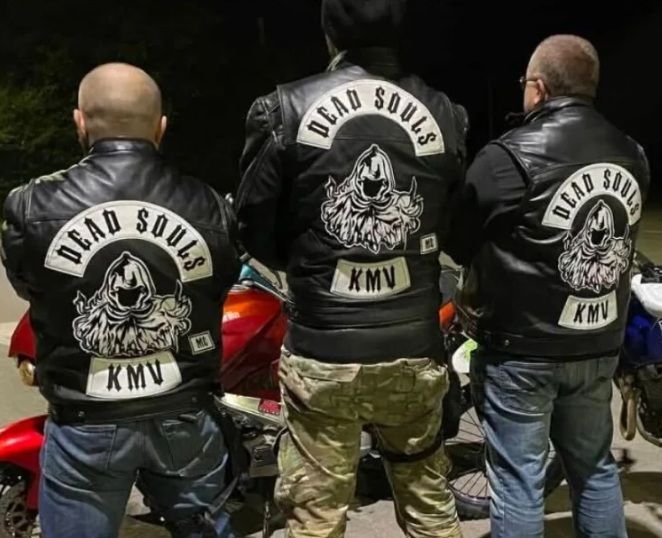
Murnev, Dudchenko, and Burmay wearing leather jackets with the name of their motorcycle club, “Dead Souls.”
Instagram account of Sergey Dudchenko
Murnev’s health has seriously deteriorated. Because of tachycardia he struggles to breathe, move, and fall asleep. For almost four months no letters arrived from him. One reply dated December 3, 2025 reached me only on February 12, 2026, although earlier letters from the same detention center usually arrived within one or two weeks.
Dudchenko was transferred to Pre-Trial Detention Center No. 3 in Novocherkassk. Human rights defenders suggested the move was due to overcrowding in the Rostov detention center.
From November 17 until early February, Dudchenko was not brought to court at all. The prison convoy service was also overstretched.
Nevertheless, hearings were scheduled and lawyers came to court, and the amount their families had to pay for legal services kept growing.
“Dudchenko’s mother is very seriously ill,” Burmay says about the families of the bikers. “Because of all this she has given up. This is a grief their family will be living with for years. Anna Murneva has learned to live alone with four children. She is still fighting and trying to help Kolya.”
After the prisoner exchange in August 2024, political prisoners and their relatives began hoping that such a chance might come for them as well. Many human rights organizations believe that the release of political prisoners should be included in peace negotiations.
Mikhail Savva, an expert at the People First, commented for the publication Explainer on the position of the Campaign, which has brought together dozens of human rights groups and lawyers.
“I do not use the word ‘exchange’ when speaking about people. You exchange money for goods. In any negotiations, the first priority should be the release of all those who lost their freedom because of the war, such as Sergey Dudchenko and Nikolai Murnev, against whom the Russian regime is brazenly using false terrorism charges.”
“For me this is one of the most striking stories,” says former political prisoner and artist Sasha Skochilenko, who was also released in the exchange, speaking about the bikers’ case. “For someone to ride out on a motorcycle with a Ukrainian flag at the head of a march of Z-patriots requires enormous courage. Stories like this need to be told, especially considering the current image of biker communities in Russia. These men have already been through torture and are in a situation where they have nothing left to lose. Now the goal is to make sure the world hears about them. We must help them.”
Skochilenko introduced me to the artist Gleb Pushev, who draws comics about protests. His work became, in a sense, a poster for this piece. He says he tried to put more than just an image into every part of the composition. I argued with him and asked him to remove the Rosgvardiya patch from the drawing. But Gleb insisted. The patch, he said, symbolizes both the problems Burmay faces in exile and the way parts of the opposition abroad see him. “Burmay carries this cursed stigma. He is not a classic liberal opposition figure. He is a man who wears camouflage, shoots rifles, has worked in the security services and does not have a perfect political biography.”
“After these three years I am already morally exhausted,” Burmay said in his last interview in November 2025. “What frustrates me most is the lack of any result. In any case, no one is going to give up and we will keep going. But whatever happens to Murnev and Dudchenko in the future, their lives will never be normal again. Never. It is impossible to forget this, to forgive it, and simply start a new life. They will carry the psychological damage for the rest of their lives. No one will be punished for this. That is the most frightening part. The thought of returning to that society and living in it. Russians killed more Russians than anyone else — now I understand what that phrase means. I sincerely hope the war with Ukraine will end. Ukraine will endure. They will be able to start a new life and learn from their mistakes. But Russia will sink further into darkness, into hatred between people multiplied a hundredfold, and those who remain in the country will suffer greatly.”