A six-day International Youth Festival opens this week in Yekaterinburg, offering foreign participants trips across Russia, master classes with Kremlin media managers, lectures from deputy prime ministers, and seminars on a "multipolar world." Foreign Minister Sergei Lavrov has promoted it to foreign diplomats as a successor to the Soviet-era youth festivals of the 1960s—the Thaw and perestroika era—when cultural exchange was a centerpiece of Soviet foreign policy.
At an April presentation held at the Foreign Ministry's mansion, Lavrov said that the arrival of 5,000 foreign participants would show that "our country is not isolated" and that young delegates would "lay the foundations for relations in the coming years and decades."
Anonymous builders of the future
Russian authorities say that 10,000 people from 190 countries will attend: 5,000 Russians and 5,000 foreigners. The organizing committee, however, has kept the full list of foreign delegates secret.
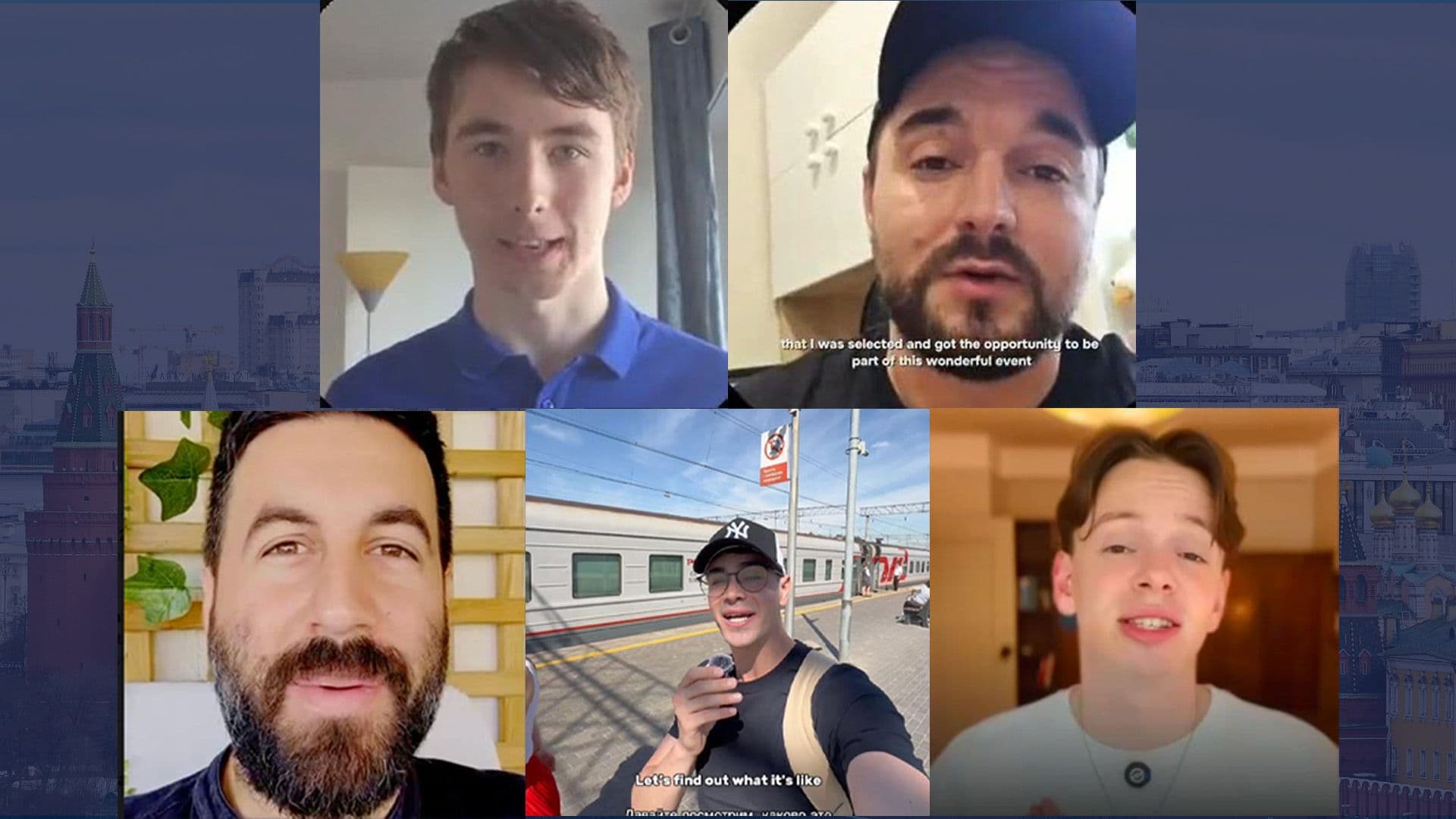
To promote the festival, organizers use two categories of foreigners: established expat bloggers who have come to "dispel myths about Russia" through their own example, and "newcomers" whose faces appear in promotional videos without their surnames or biographical details.
A young man in a blue T-shirt looks into the camera and smiles. "Hi everyone! My name is Andrei, and I'm going to the International Youth Festival representing France," he says in English, with a slight East Slavic accent.
The 34-second video message—a so-called "circle" video, a short Telegram video message—appeared on the official English-language Telegram channel of the Directorate of the World Youth Festival. Organizers introduced him simply as "André from France," without giving his surname or place of study, and added vaguely that his festival dream was to "discover new cultures and communicate with experts from different countries."
Screenshot from the festival’s Telegram channel showing the video message “André from France.”
@wyffest_en
Using open-source information and the OSINT Industries platform, we identified the speaker in the video.
A screenshot from the video matched a photograph on the website of Forum des Jeunes, a Belgian government youth platform. In the photograph, taken at the Paroles de jeunes ("Youth Voices") debate, the same young man appears in the sixth row of participants.
Facial comparison between the person in the festival's Telegram video and the group photograph from Forum des Jeunes.
dialoguejeunesse.be
"André from France" turned out to be André Shevchenko, who grew up in Belgium and speaks Russian and French. He does not fit the profile of the pro-Russian expat bloggers: He is not a public influencer, does not maintain public-facing blogs, and has left very little trace on social media. His only professional profile is a LinkedIn page without a photograph.
From Brussels debate stages to the Urals
Until the summer of 2026, Shevchenko studied at the Lycée Français Jean Monnet in Brussels. He won physics and mathematics competitions, and in April 2024 won the regional round of Ambassadeurs en herbe, a public-speaking competition for Northwestern Europe and Scandinavia.
Shevchenko regularly appeared at European public events. In December 2025, he visited the European Parliament for the Jacques Delors Book Prize ceremony, whose jury was chaired by the Ukrainian writer Andrei Kurkov, a well-known critic of Vladimir Putin.
In spring 2026, as part of Paroles de jeunes, Shevchenko prepared proposals for democratic reform and presented them in person to Benoît Dispa, president of the Parliament of the French Community Commission.
His résumé also includes a two-month summer internship in the office of a sitting Member of the European Parliament.
Technically, Shevchenko qualifies as a French delegate only because he moved to Paris in August 2026 to enroll in a joint bachelor's program at Sciences Po Paris and the Sorbonne. This recent move allowed organizers to assign the Brussels-based student to France's quota.
His entry point to the festival ecosystem was the Russian House in Brussels, run by Rossotrudnichestvo, Russia's state agency for cooperation with compatriots abroad. In April 2025, he won its Living Classics recitation contest, and that autumn attended acting master classes there.
For an obscure teenager, the Russian House became a gateway to the festival.
"Russian Houses and Russian embassies around the world are gathering future participants," the festival directorate said in a post about Rossotrudnichestvo's role.
The festival was also promoted on United Nations platforms. Grigory Gurov, head of Russia's Federal Agency for Youth Affairs and a sanctioned official, traveled to New York to promote it. In Paris, a cooperation center for Russian compatriots and French young people aged 14 to 35 opened in February at the Russian House, with the participation of the festival directorate, ANO Directorate of the World Youth Festival. At the opening, a representative of the directorate presented the festival and announced a "School Diplomacy" project. (We previously reported on the student-run fake-account factory created as part of the same ecosystem behind the Doppelgänger project.)
Expatriates with no past
"We want to show young leaders the real Russia — a country of limitless opportunities, where people know how to dream and turn their dreams into reality. It is no coincidence that the 2026 festival motto is 'Follow your dream. Together with Russia,'" Sergei Kiriyenko, the festival's organizing committee chair and first deputy chief of staff of the Russian president, said at the committee's first meeting on January 27 in Moscow.
The festival's promotional campaign centers on foreigners embedded in Russia's state propaganda apparatus—presented as independent creators, though their pre-Russia biographies have been erased or repackaged for propaganda.
On his way to the festival, Diego Rodriguez talks about Russian trains from an open-plan third-class carriage. The festival program includes a talk by the head of Russian Railways.
Instagram Diego
Diego Rodriguez (Diego in Russia). Festival materials describe him as a Barcelona-based blogger with a significant social media following. In an interview with pro-Kremlin media, including Tsargrad, Rodriguez says he became interested in Russia at school through history lessons and began traveling around the country extensively in 2024. However, all his social media accounts date to 2024 or later and have no connection to his life in Spain. His Facebook profile lists Moscow as his place of residence. He describes his goal as showing that Russia is not a closed country, but a welcoming and safe destination for tourists.
Screenshot from the Rossiya state television program Vesti Pskov. Artur Hard is in the center.
“And then I realized that my task was to show the world what Russia is really like,” says Artur Hard, a blogger from Germany.
Vesti.ru
Artur Hard. He also recorded a short festival video message—for unexplained reasons in German—although he speaks Russian fluently, as shown in an April 2026 report by the state broadcaster Rossiya titled "Foreign bloggers came to Pskov to tell the truth about Russia." The German blogger has lived in Yaroslavl since 2022. He says his aim is to "break through the information blockade" and makes videos about Soviet marshals.
Hard is a resident of the International Content Center, or ICC, created by the festival directorate and presidential-administration structures, including ANO Dialog and the New Media Workshop, to distribute pro-Kremlin content abroad. He has not publicly disclosed his education, profession, or hometown in Germany. His Revolut financial profile is registered in Poland.
Sébastien Piriou tells Russian media that, before moving to Russia, he thought the country was “George Orwell” — but found that reality was different.
@wyffest_en
Sébastien Piriou. The 26-year-old Frenchman is studying for a master's degree at the Faculty of International Relations of Saint Petersburg State University. Piriou runs blogs about everyday life, the cost of living, the metro, and Soviet history, including Stalingrad and the Lenin and Victory museums. On TikTok, he jokes about his critics: "I'm a Russian propagandist … at least according to my critics!" He avoids the war against Ukraine entirely in his videos. Organizers recruited Piriou for the 2026 festival as a "blogger-expert" whose role is to help young creators "tell their stories correctly."
Christopher Helali. Festival resources describe him as an "American historian and correspondent for DD Geopolitics." In reality, he is a left-wing American activist who ran for Congress in Vermont in 2020 and later co-founded the American Communist Party (ACP). He has lived in Moscow since 2025, works with RT and Sputnik, visited occupied Starobilsk, and serves as an expert for the Global Fact-Checking Network (GFCN), an association created by Dialog. At the St. Petersburg International Economic Forum in summer 2026, Helali publicly asked President Vladimir Putin to grant him Russian citizenship in return for his "work in Donbas."
How to get to the festival — and who pays
To understand how a little-known student at a European university ends up in the Urals, it is enough to look at the festival's regulations.
The main criterion in the foreign-participant competition was a two-minute video introduction. Experts assessed charisma, presentation, and the ability to speak on camera. A secondary filter for free expeditions across Russian regions favored applicants with at least 2,000 blog followers when scores were tied.
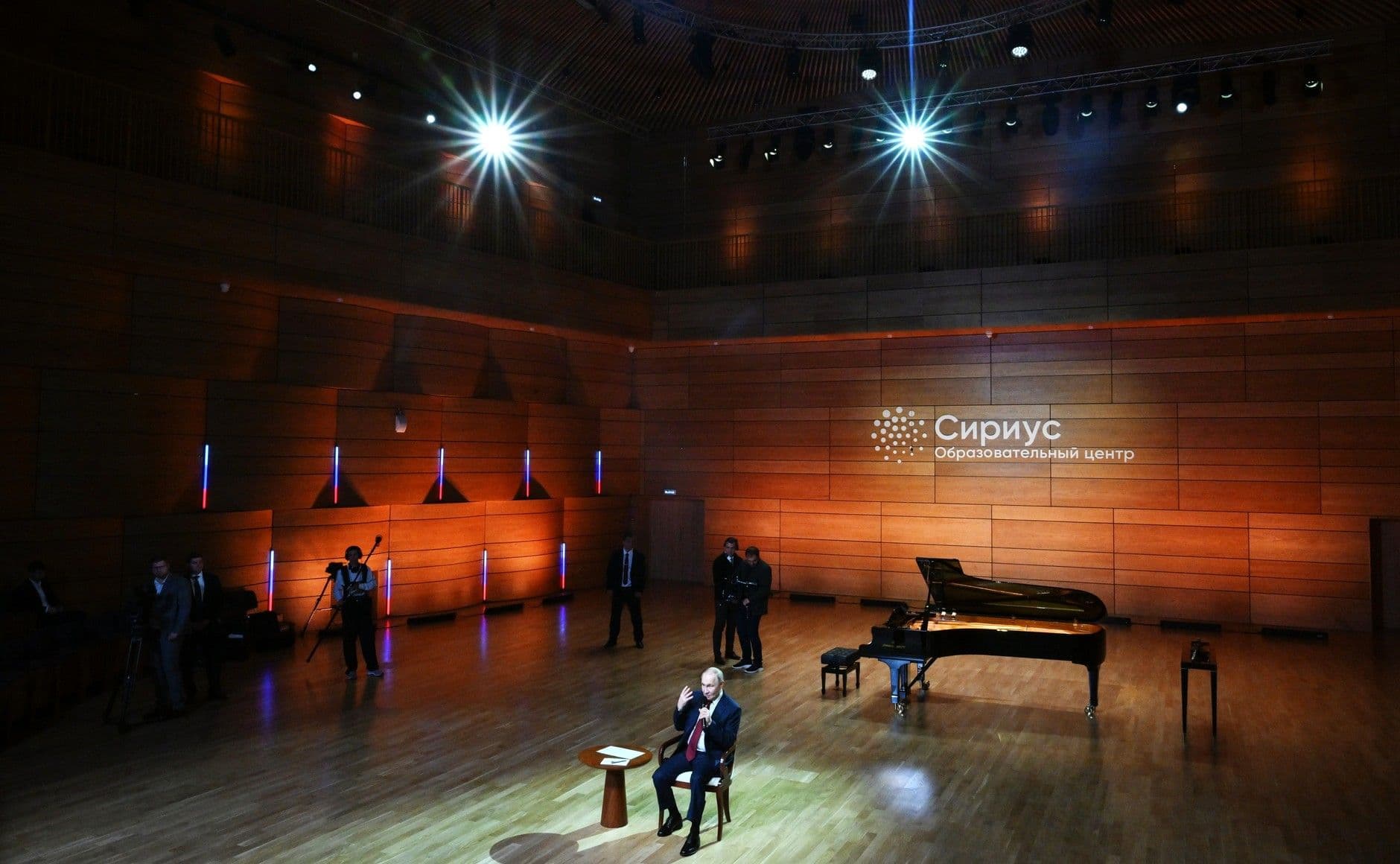
For contest winners, the festival operator ANO Directorate of the World Youth Festival, the pro-Kremlin Movement of the First, and the Russian budget fully cover round-trip flights to Yekaterinburg. The host side also provides accommodation, meals, insurance, and subsequent trips to 35 Russian regions, the Sirius cluster, and the occupied territories of Abkhazia and South Ossetia.
In Yekaterinburg, arriving foreigners are greeted with glossy pageantry: round dances to the tune of "Kalinka," a sable named Uralik, and one-ruble metro rides paid for through biometric identification.
The lecture program is overseen by the Znanie Society, whose supervisory board is chaired by Kiriyenko. The announced speakers include Deputy Prime Minister Marat Khusnullin, who oversees construction projects in the occupied territories of Ukraine; Deputy Prime Minister Dmitry Chernyshenko, whose portfolio includes youth and digital policy; and Oleg Belozyorov, head of Russian Railways.
The cultural and entertainment program includes Putin confidant and saxophonist Igor Butman, as well as singers Dmitry Malikov and Nadezhda Babkina. The main prize at the end of the program is a trip to Abkhazia and South Ossetia — breakaway territories that separated from Georgia with Russian support after the 2008 war.
Dialog’s media pipeline — and the German connection
One track is devoted to information and media. Participants are offered an “Anti-Fake Championship,” a “Neurocontent Cup,” and a section at the “Media Stream” venue.
The festival’s media program is run by ANO Dialog Regions, headed by Vladimir Tabak. The organization and its head are under U.S. and UK sanctions for disinformation. While the head of Russia’s Federal Agency for Youth Affairs speaks about “media literacy” at United Nations events, Tabak describes the platforms created by Dialog inside Russia as “digital weapons” and a “digital air-defense system” against Western fake news.
The system works through three main bodies:
New Media Workshop: a project of Dialog and the presidential platform Russia — Land of Opportunity.
International Content Center: a hub coordinating foreign creators, established in late 2025 to produce regular videos about Russia.
Global Fact-Checking Network: an association launched by Dialog and the TASS news agency. At discussions in Yekaterinburg, it sets the framework by labeling independent investigations into Moscow’s actions “Western fake news.”
A key link between these bodies is Daniil Bisslinger: a former diplomat in Paris and Berlin, Putin’s interpreter, former head of ANO Directorate of the World Youth Festival, and vice president of GFCN.
His background is connected to influence operations in Europe. According to 2017 documents from the Russian presidential administration published by Der Spiegel and The Insider(*), Bisslinger coordinated contacts in Berlin with the office of Markus Frohnmaier, a Bundestag member from the far-right Alternative for Germany party, or AfD.
The Kremlin documents stated the goal explicitly: “We will get our own completely controlled member of the Bundestag.” They also proposed financing a network of front organizations posing as European NGOs.
As we previously reported, the same ecosystem also includes a factory of fake accounts staffed by students from the Moscow State Institute of International Relations, or MGIMO, and created as part of the Doppelgänger project.
The cost: billions for “Russia in the World”
The scale of this foreign recruitment effort was built into Russia’s federal budget. In 2026, the Kremlin earmarked 11.86 billion rubles for the “Russia in the World” federal project — more than twice the amount allocated the previous year. A further 10.4 billion rubles is planned for each of 2027 and 2028.
The main operator of this money is the ANO Directorate of the World Youth Festival. Its 2026 budget increased almost fivefold, to 4.7 billion rubles, according to the approved state budget. Another 500 million rubles was allocated for direct grants to foreign participants.
By comparison, the government allocated about 1.5 billion rubles in 2026 to developing the entire network of youth clubs and centers across Russia’s 89 regions.
Control over the project is concentrated in the presidential administration. In autumn 2025, Vladimir Putin reorganized Russia’s “soft power” structures, creating the Directorate for Strategic Partnership and Cooperation. It is headed by Vadim Titov, a former Rosatom official and ally of Sergei Kiriyenko.