How Sirius’s gifted children serve wartime “nationalization” — and Alina Kabaeva / How Putin’s Cellist Sergei Roldugin Helped Channel State‑Seized Assets to Alina Kabaeva’s Circle
At the Heavenly Grace Academy in Sirius, rhythmic gymnastics is taught under former Olympic champion Alina Kabaeva. Preschoolers hear stories about a doll named Alina; the tales, produced by the Talent and Success foundation in Kabaeva’s image, remain unreleased publicly. Videos show teachers using the narratives to promote early participation in gymnastics. Legally, there is no formal link between Talent and Success and Heavenly Grace beyond a shared Sirius address.
In 2025, Talent and Success spent 3.5 billion rubles on educating gifted children. That year the foundation wired 10.3 billion rubles to Heavenly Grace—nearly three times its annual education spend.
This report examines how Sergei Roldugin’s foundation has become a repository for assets seized in corruption cases and a conduit for funds to Kabaeva’s academy and other enterprises tied to Russia’s political inner circle.
Alina Kabaeva with a book about the adventures of the doll Alina. The story, according to the teachers’ concept, is meant to motivate young pupils to take up rhythmic gymnastics. Photo: Heavenly Grace social media.
Alina Kabaeva with a book about the adventures of Alina the doll, a gift from Sirius teachers.
The Sirius National Project
On the Sochi coast, former Olympic facilities now sit in Sirius, a federal territory dedicated to nurturing talent. Official materials describe Sirius as unusually resourced and mission-driven. Putin has said the idea arose from him: transferring the venues and land to a foundation controlled by Sergei Roldugin, whom he credits with introducing him to music.
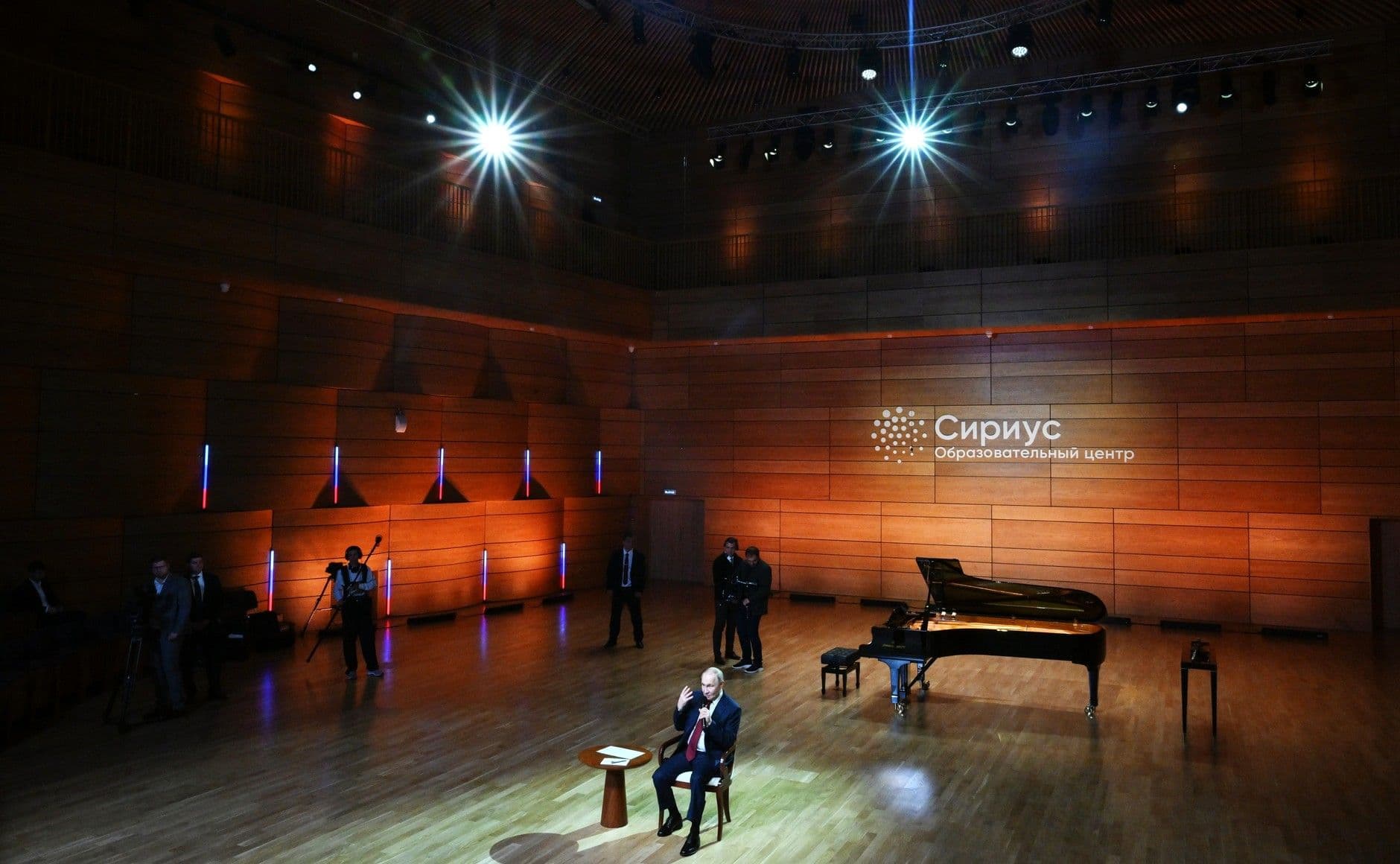
“This was the idea of the Olympic legacy—that it should serve our country, serve the people in the best possible way,” Putin said during a 2025 visit to the Sirius music school.
The foundation’s board of trustees is chaired by Putin. Roldugin heads the management board. Day‑to‑day operations are run by Yelena Shmelyova, head of Sirius and co‑chair of Putin’s People’s Front.
A decade ago, OCCRP and Novaya Gazeta described billions of dollars flowing through offshore networks nominally controlled by Roldugin on behalf of Putin’s circle. Putin defended Roldugin,1 saying the money financed instruments for state use, including rare Stradivari violins. Now, the assets are housed in Sirius, created in 2020 after constitutional amendments.
In August 2024, the Talent and Success charter was updated. The foundation can no longer be dissolved or merged. Its activities expanded to 37 areas, including education, healthcare, logistics, and securities.
By the end of 2025, Talent and Success reported 306.8 billion rubles in assets. Over 11 years, it spent about 61 billion rubles on educating and supporting children—less than a fifth of reported assets.
The foundation’s assets exceed Gazprom’s Gazprom Social Initiatives by about 2.2 times.
In 2025, Talent and Success posted net income of 16.16 billion rubles. Rather than channeling this surplus to education and child support, it reduced those expenditures to 3.55 billion rubles.
Putin meets with students and teachers at the Sirius center, which is run by Sergei Roldugin’s Talent and Success foundation, 2025.
Kremlin press service
From Offshore to Foundation
In 2025, Talent and Success reported income of 122.8 billion rubles, more than double the prior year. Direct subsidies to Sirius fell to 4.6 billion rubles, less than 4 percent of total inflows.
The growth came from assets seized in corruption cases. In 2025 and January 2026, the foundation and its subsidiaries gained control of assets valued at about 78 billion rubles, the result of confiscations in high‑profile prosecutions.
This pattern traces back to earlier enrichment schemes around Sergei Roldugin. In 2025, the Prosecutor General’s Office charged three former Gazprom executives—Kirill Seleznev, Ivan Mironov, and Alexei Mityushev—seeking to confiscate assets. Fifteen years earlier, Seleznev and Mironov participated in Bank Rossiya transactions; the Panama Papers showed Roldugin’s offshore Sandalwood Continental earning 420 million rubles in two days.
In 2025, prosecutors confiscated assets from Seleznev, Mironov, and Mityushev and redirected them to Roldugin’s foundation, bypassing the Federal Agency for State Property Management, competitive bidding, and public reporting.
Part of these assets, per settlement documents, will fund “scientific, educational, and outreach goals determined by the state.” Putin has said such transfers do not amount to privatization; documents show the assets moved to the president’s associate’s foundation without competitive process or public disclosure.
Sergei Roldugin is a cellist and friend of Vladimir Putin, and the founder of the Talent and Success foundation, which gathers not only gifted children but also nationalized businesses. Photo: TASS
Deals of the Past
In 2010, Bank Rossiya merged with Gazenergoprombank, doubling assets and raising the bank’s profile. Kirill Seleznev represented Gazprom’s interests. A month before the merger, Roldugin’s offshore Sandalwood Continental acquired Rossiya shares and sold them two days later for a 420 million ruble profit.
In 2013, Gazprom Gazoraspredelenie sold its stake in Bank Rossiya to entities controlled by Ivan Mironov, who became the bank’s second‑largest shareholder. Mironov also served as deputy CEO of ExpoForum-International and owned the Aviapark center through Oberon Estate LLC.
Asset transfers used closed‑end funds (ZPIFs), managed by Mercury Capital Trust. Novaya Gazeta described the scheme as a way to “legally obtain money from the sale of several companies’ assets in bulk.” Alexei Mityushev, Seleznev’s partner, moved assets from offshore to Russian ZPIFs.
ExpoForum Properties
The foundation received ExpoForum at no cost. It also acquired Lenexpo. The foundation directly owns 75 percent of ExpoForum JSC and 25 percent through Zenit‑M. ExpoForum’s book value is 11.7–12 billion rubles; 2025 net profit was 296 million rubles. Lenexpo net profit was 196 million rubles. The foundation derives revenue as owner.
The network includes Oberon Estate, with office real estate valued at 14.9 billion rubles; Aviapark in Moscow is among its assets. TsINTEX controls four distribution centers totaling 694,000 square meters. Ekolamelli owns luxury residential properties via subsidiaries.
Opacity by Design
About 48 billion rubles arrived via six ZPIFs: Zenit‑M, Remez, Doverie, Proyektnye Investitsii‑II, FinPanoramaClub, and Universalnye Investitsii. ZPIFs obscure asset holdings; their compositions are not public.
Only two funds disclose their holdings: Zenit‑M holds 25 percent of ExpoForum JSC and 100 percent of Lenexpo; Doverie holds 100 percent of KBK Nedvizhimost and minority stakes in Oberon Estate and Tekhsnabservis. The other four show only registration numbers.
Mercury Capital Trust manages all six funds; a 2025 court order moved the firm to state control.
Nonprofits like Talent and Success face no mandatory remittance of confiscated asset value to the budget, unlike state corporations. The foundation takes assets free of charge.
Anti‑corruption expert Ilya Shumanov calls the arrangement “reputational laundering.” He notes that assets seized in one era reappear in Roldugin’s foundation, bypassing public reporting. He describes a system of multiple asset pools that obscures true ownership and beneficiaries, and he cautions that the foundation’s position resembles a final beneficiary of state assets.
Partnerships with the inner circle appear at the St. Petersburg Economic Forum, where Yelena Shmelyova signs with actors from the president’s circle. Bank Rossiya, the Defenders of the Fatherland fund, RDIF, and Gazprombank appear on partnership lists; public results are not reported.
By late 2025, Bank Rossiya held about 125 billion rubles of the foundation’s deposits. The foundation shifted its operating accounts to long‑term deposits.
Putin never tires of displaying his affection for young gymnasts. In this frame, he is seen during a recent visit to a St. Petersburg sports school named after his first judo coach, Anatoly Rakhlin.
Still from a video by journalist Pavel Zarubin
Deripaska Donations
The foundation’s second‑largest income source is corporate donations: 33.3 billion rubles in 2025. Since the invasion of Ukraine, donors contributed 57 billion rubles over three years—more than in the five prewar years combined.
In 2026, a closed‑door meeting with Putin reportedly yielded a pledge of 100 billion rubles from Suleiman Kerimov. The only publicly named donation in 2025 was 12.6 billion rubles in EN+ Group shares from Oleg Deripaska, transferred on October 31, 2025 amid court rulings over the Imeretinsky hotel.
Note on the October 31, 2025 transfer of 31,942,444 EN+ Group shares (just under 5 percent) into the direct ownership of the Talent and Success foundation.
Deripaska’s assets include the Imeretinsky hotel and yacht marina. Investigative reports in 2025 disclosed a case in which a minor named Deripaska as her client; Deripaska sued to halt reporting. Roskomnadzor briefly blocked materials; the case moved to Moscow and stalled. Deripaska later deleted Telegram posts before November 1, 2025 after transferring shares to the foundation; Roskomnadzor did not intervene, signaling uneven regulatory support for the regime’s allies.
Proekt and others note that spikes in donations often align with Kremlin decisions on major deals. In April 2025, Putin visited Sirius‑affiliated schools and kissed a gymnast at the Olympic Reserve School named after Anatoly Rakhlin.
The Kabaeva Transfer
On March 10, 2025, Talent and Success transferred 10.327 billion rubles to Alina Kabaeva’s Heavenly Grace Academy. The auditor recorded the transfer as an event after the reporting date. The amount exceeded the federation’s federal subsidies for the year and was 92 times the academy’s 2025 gymnastics spending.
Talent and Success foundation audit note stating that, under a March 10, 2025 donation agreement, 10.327 billion rubles were transferred to Alina Kabaeva’s “Academy of Rhythmic Gymnastics.”
Heavenly Grace reported 3.3 billion rubles in donations from an unnamed Russian entity. It recorded 139 million rubles for operating expenses and 112 million for targeted activities. The 10.327 billion ruble transfer dwarfed these figures and appeared on the cash-flow line as “other payments,” alongside 14.7 billion rubles in total cash flow for the year.
Gazprom donated the Heavenly Grace building, valued at about 2.2 billion rubles. The transfer from Sirius equates to roughly 4.7 times the building’s value.
In the same month, investigators pressed a criminal case into the 8‑billion‑rubled theft at the Sochi Rhythmic Gymnastics Center. Investigators allege that 2016–2019 funds were misappropriated and laundered; defendants included two Gazprom executives tied to Kirill Seleznev’s circle.
Talent and Success’ banking relationship centers on Bank Rossiya, where deposits exceed 125 billion rubles. Kabaeva’s own deposits total about 1.6 billion rubles.
With Kabaeva, Sirius officials opened the Heavenly Grace Cup in a Gazprom‑donated building.
Remuneration and Governance
In 2025, Talent and Success paid its top five executives a combined 41.1 million rubles. Roldugin, the founder, receives no salary.
Tax records show Roldugin earned 19.99 million rubles from Bank Rossiya in 2021 and at least 18.1 million from cultural institutions that year. By February 2025, his Bank Rossiya deposit stood at about 140.3 million rubles, earning roughly 29.06 million in interest that year. He held smaller sums at Sberbank and Gazprombank.
Education operations rely on subsidiaries such as the Presidential Lyceum and Sirius University, which charge tuition to fund core activities.
Asset Repackaging
In 2025, Talent and Success transferred a 9.27% stake in PhosAgro to two affiliated foundations run by Alexander Komolov. The parent foundation’s dividend income collapsed in 2025, while the two new foundations earned substantial net profit. Roldugin’s foundation wrote off 67.6 billion rubles as “other expenses” related to these transfers.
New Revenue Streams
In March 2026, the foundation gained a stake in Muzyka, Russia’s oldest music publisher, whose 2024 revenue was 109 million rubles. The stake was seized from CEO Mark Zilberkwit in a Prosecutor General’s Office action over alleged privatization irregularities. The asset will appear in future financial reports. In January 2026, the foundation became the sole founder of Kazakhstan‑Sirius LLP in Almaty, establishing a Sirius model for 1,600 children.